J. David Frost

Elizabeth and Bill Higginbotham Professor
Regents' Entrepreneur
Telephone
Office Building
Mason
Office Room Number
2285
Biography

Dr. J. David Frost is the Higginbotham Professor in Civil Engineering at the Georgia Institute of Technology and a Regents’ Entrepreneur. He obtained BA and BAI degrees in Mathematics and Engineering from Trinity College, Dublin, Ireland and MS and PHD degrees in Civil Engineering from Purdue University, West Lafayette, Indiana, USA. Throughout his research and teaching career, he has studied natural and man-made disasters and their impacts on infrastructure at multiple scales using digital data collection systems.

Involvement in international activities has been a cornerstone of Frost’s career for more than 30 years. His past and ongoing activities have included roles in committees of the International Society of Soil Mechanics and Geotechnical Engineering (ISSMGE) including TC-302 Forensic Geotechnical Engineering, TC-105 Geo-mechanics from Micro to Macro, and as an advisor to the Ad-hoc group to establish a new ISSMGE Board Level committee called “Geo-engineers Without Borders”. When coupled with his extensive international activities as a founding member and current Chair of the US NSF funded Geotechnical Extreme Events Reconnaissance (GEER) Association that coordinates geotechnical responses to natural and man-made disaster worldwide, he has seen what nature can do at its angriest to our infrastructure and planet. He has personally participated on and/or led teams responding to disasters in US, Chile, China, Turkey, Japan and India amongst others.

Research

Frost maintains a very active research program with significant external funding from federal and state agencies as well as industry donations. He has had continuous NSF funding since 1990 dating back to his first proposal submitted to the agency. Apart from individual investigator projects, he served as co-PI and GT lead for the NSF Engineering Research Center on Bio-mediated and Bio-inspired Geotechnics.  The total center funding was $35M and involved four universities. Other sources of funding for his research activities include NIST, USGS and GDOT. Frost has graduated 48 PhD’s and is currently advising 11 PhD’s. This well-funded research program has enabled Frost to actively pursue his entrepreneurial interests.

Education

Ph.D., Civil Engineering                       Purdue University, Indiana, USA                       1989       

M.S.C.E., Civil Engineering                  Purdue University, Indiana, USA                       1986

B.A.I. (Hons), Civil Engineering            Trinity College, Dublin, Ireland                          1980            

B.A., Mathematics                                 Trinity College, Dublin, Ireland                           1980                

Diploma, Technical French.                   Trinity College, Dublin, Ireland                           1980            

Teaching

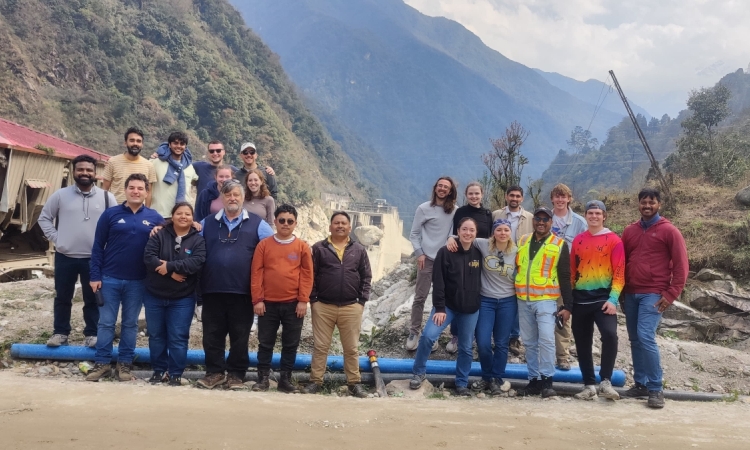
Frost appreciates the importance of cultural differences in addition to engineering practice in foreign countries and this has led to the development of a course he teaches at Georgia Tech on International Disaster Reconnaissance. This course, which includes a 10-day field trip to areas that have been impacted by extreme events, provides students with first-hand experience of the incredible forces that nature can bring on human infrastructure, learn about post-disaster reconnaissance methods and observe reconstruction activities. Through this course, he has taken students to Japan, China, India, Nepal and S. Korea. Beyond his international teaching activities, Frost also has numerous ongoing international research collaborations in Canada, Chile, Brazil, France, Italy, Switzerland, Japan, China, India, Nepal, United Kingdom, and Ireland. The richness of ideas that emerges from such collaborations reinforces the merits of international engagement. Having worked internationally in both industry and academia, as well as more recently being involved in several geotechnical start-up companies, Frost has a strong appreciation of the opportunities that exist at the intersection between research, practice and entrepreneurship.

Distinctions & Awards
  • Civil Engineering Alumni Achievement Award, Purdue University, 2025
  • ASCE Life Member Fellow, 2024
  • Osterberg Lecture, Northwestern University, 2023
  • ASCE H. Bolton Seed Medal, Los Angeles, 2023
  • Prakash Distinguished Lecture, Missouri University of Science & Technology, 2021
  • AASHTO Region 2 High Value Research Award, 2019
  • ASCE Journal of Geotechnical & Geo-envir. Engineering, Editor’s Choice Award, October, 2018
  • Leonards Lecture, Purdue University, 2016.
  • ASCE Fellow, Elected 2011.
  • Geo-Shanghai International Conference, ASCE GSP #200, Best Paper Award, 2010.
  • Burmister Lecture, Columbia University, 2008.
  • Georgia Society of Professional Engineers, Engineer of the Year in Education, 2008.
  • ASTM International Hogentogler Award, 2003.
  • ASTM Standards Development Award, 2002.
  • ASCE Walter L. Huber Civil Engineering Research Prize, 2001.
  • Kentucky Geotechnical Engineering Society Distinguished Lecture, University of Kentucky, 2000.
  • National Science Foundation National Young Investigator Award, 1994-1999
Publications
  1. Lozano, J.-M., Nichols, E., Frost, J.D., and Tien, I., (2024), “Impact of Ground Motion Uncertainty Evolution from Seismic Datasets on Post-earthquake Data on Building Damage”, Earthquake Spectra, Vol. 40, No. 4, doi.org/10.1177/87552930241266808.
  2. Zhang, D., Roy, N., and Frost, J.D., (2024), “A Data Driven Approach to Optimize the Design Configuration of Multi-Sleeve Cone Penetrometer Probe Attachments”, Computers and Geotechnics, 169, 106248. https://doi.org/10.1016/j.compgeo.2024.106248
  3. Moss, R.E.S., Altunel, E., Bassal, P., Bray, J.B., Buckreis, T., Cetin, K.O., Clahan, K., Duman, E., Frost, J.D., Hashash, Y., Koehler, R., Kozaci, O., Lozano, J.M., Macedo, J., Moug, D., Nichols, E., Pehlivan, M., Pretell, R., Stewart, J., Ulmer, K., Yildirim, C., (2024), “Geotechnical and Geological Reconnaissance Observations of the February 6th, 2023 Turkiye Earthquakes”, Earthquake Spectra, Vol 41, No. 1, https://doi.org/10.1177/87552930241281007.
  4. Cetin, K.O., Moug, D., Soylemez, B., Ayhan, B.U., Zarzour, M., Al Suhaily, A., Akil, B., Unutmaz, B., Firat, S., Tekin, E., Cakir, E., Frost, J.D., Macedo, J., Bray, J.D., Moss, R.E., Bassal, P., Gurbuz, A., Işık, N.S., Akin, M., Sahin, A., Duman, E., (2024), “Ground Failures and Foundation Performances in Adiyaman-Gölbasi Following the February 6, 2023, Kahramanmaras-Türkiye Earthquake Sequence”, Earthquake Spectra, Volume 41, No. 1, https://doi.org/10.1177/87552930241270581
  5. Zhang, D., Jindal, D., Roy, N., Vangla, P., & Frost, J. D. (2024). Enhancing landslide susceptibility mapping using a positive-unlabeled machine learning approach: a case study in Chamoli, India. Geoenvironmental Disasters 11, 21. https://doi.org/10.1186/s40677-024-00281-w
  6. Zhang, D; Huang, H; Smith, N.S; Roy, N; Frost, J.D. (2025), “From Pixel to Damage Severity: Estimating Earthquake Impacts Using Semantic Segmentation of Social Media Images.” arXiv. https://doi.org/10.48550/arXiv.2507.02781
  7. Kurugodu, H.V., Bhattacharya, D., Vangla, P, and Frost, J.D., (2025), “Numerical Investigation of Compound Bio-inspired Cone Pressuremeter Probe Mechanisms with Material Point Method”, Computers & Geotechnics Vol. 179, DOI:10.1016/j.compgeo.2024.107013
  8. Liu, J., Roy, N., and Frost, J.D., (2025), “3-D Printing and Lab Scale Testing of Bio-inspired Geogrids for Road Rutting Reduction”, Bio-geotechnics, on-line, https://doi.org/10.1016/j.bgtech.2025.100188
  9. Huang, H., Zhang, A., Zhang, D., Roozbahani, M. M., & Frost, J. D., (2025), “DASeg: A Domain-Adaptive Segmentation Pipeline Using Vision Foundation Models – Earthquake Damage Detection Use Case”, Remote Sensing, on-line, https://doi.org/10.3390/rs17162812 
  10. Huang, H., Zhang, D., Masalava, A., Roozbahani, M. M., Roy, N., & Frost, J. D., (2025), Towards Enhancing the Utility of Social Media Images in Earthquake Disaster Assessment, Earthquake Spectra, doi 10.1177/87552930251335649
  11. Zhang, D., Roy, N., Wang, R., & Frost, J. D., (2025), Predicting Tornado-Induced Building Damage: A Comparative Study of Tree-Based Models and Graph Neural Networks, International Journal of Disaster Risk Reduction, doi 10.1016/j.ijdrr.2025.105525
  12. Huang, H; Liu, C; Zhang, D; Patel, S; Masalava, A; Sadak, S; Babolhavaeji, P; Low, W; Roozbahani, MM; Frost, J.D, (2025). “EIDSeg: A Pixel-Level Semantic Segmentation Dataset for Post-Earthquake Damage Assessment.” AAAI AI for Social Impact (AISI),
    https://doi.org/10.48550/arXiv.2511.06456
  13. Liu, C., Shen, C.M., Liu, S.H., Huang, H.L., and Frost, J.D., (2025), “Machine Vision-based Intelligent Analysis Framework for Particle Breakage in Roller-compacted Rockfills”, Automation in Construction, DOI:10.1016/j.autcon.2025.106633
  14. Oner, C., and Frost, J.D., (2025), “Framework for Designing Next-Generation Geogrids”, Geosynthetics International, December, DOI:10.1680/jgein.25.00138.
  15. Belachew, M., Stamati, O., Viggiani, G., Lees, A., Wayne, M.H., and Frost, J.D., (2026), “Experimental Study of Geogrid Reinforced Aggregates Using X-Ray CT”, Geotechnique Letters, January, DOI:10.1680/jgele.25.00057.
  16. Belachew, M., Liu, Y., Frost, J.D, and Arson, C.F., (2026), “Numerical Assessment of Plasticity Development and Energy Expenditure of Ant-like Micro-Tunnelling”, Tunneling and Underground Space Technology, doi: 19.1016/j.tust.2026.107501.

In the News

CEE Faculty Named Regents' Entrepreneurs, Professors and Researchers

16 August 2023

Three faculty members received the University System of Georgia’s highest recognition for academic, research, and innovation excellence at the August meeting of the Board of Regents. Rafael Bras was named a Regents’ Professor, M. Talat Odman a Regents’ Researcher, and J. David Frost a Regents’ Entrepreneur.