K. Harrison Brown Family Chair and Professor,
Regents' Professor
Biography
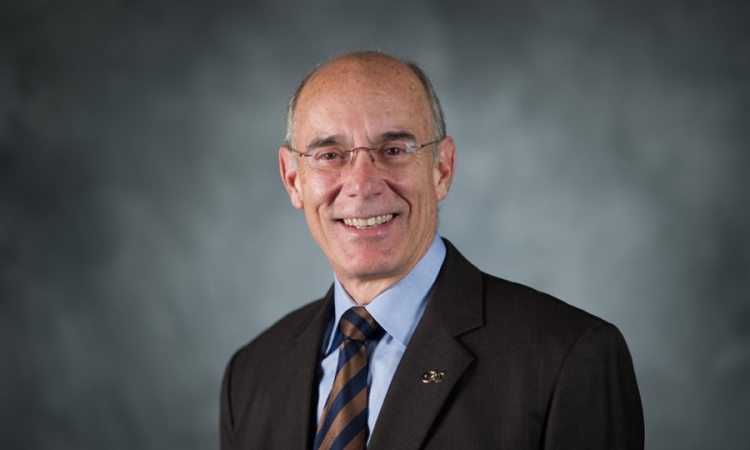
A native of Puerto Rico, Rafael L. Bras is a professor in the School of Civil and Environmental Engineering and School of Earth and Atmospheric Sciences at the Georgia Institute of Technology. He holds the K. Harrison Brown Family Chair.
Dr. Bras was provost and executive vice president for Academic Affairs at the Georgia Institute of Technology. Prior to becoming provost, Dr. Bras was Distinguished Professor and Dean of the Henry Samueli School of Engineering of the University of California, Irvine (UCI). For 32 years prior he was a professor in the departments of Civil and Environmental Engineering and Earth, Atmospheric and Planetary Sciences at MIT. He is past Chair of the MIT Faculty, former head of the Civil and Environmental Engineering department and Director of the Ralph M. Parsons Laboratory at MIT.
Dr. Bras has served as advisor to government and private institutions. Some of the most significant include: Advisory Board, Engineering Directorate, NSF; Board of Atmospheric Sciences and Climate, NRC; Chairman, Earth Systems Sciences and Applications Committee and the NASA Advisory Committee; NAS Committee on New Orleans Regional Hurricane Protection Projects. He has been an advisor to departments at Cornell, Princeton, Johns Hopkins, Technion, RPI, University of Puerto Rico, UCI; and to the Instituto Veneto, Stockholm Water Foundation and Prize, and Clarke prize. He was a director of AGU and member of the Board of Trustees of UCAR. He served on the Coursera University Advisory Board and the Blackboard Advisory Council. He is an emeritus member of the board of Foundation for Puerto Rico. He has served in the Board of Directors of Fundación Chile and the trustees of the UCI Foundation. He was a member of the Secretary of Energy Advisory Board. Ongoing external service roles include the President’s Council of the U. of Illinois; Nominations Committee of the National Academy of Engineering, the American Council of Engineering Companies Research Institute Advisory Board, the US President’s Committee on the National Medal of Science and the Georgia Tech Research Institute External Advisory Council and the Fulbright Scholar Advisory Board.
Research
Dr. Bras is a hydrologist, hydrometerologist and ecohydrologist. His interests are broadly in understanding land-atmosphere interactions as mediated by soils and vegetation. Most of his work uses satellite observations of Earth surface processes and fluxes, particularly soil moisture and rainfall. He has made key contributions in: uncertainty characterization and stochastic representation of hydro-climatic processes and data; optimal design of data acquisition networks for hydro-climatic processes; optimal assimilation of real-time observational data for the adaptive estimation of operational hydro-meteorological forecasting models; flood and drought forecasting and management; soil-vegetation-atmosphere interactions in the water cycle; integrative modeling and improved prediction of hydro-climatic processes at regional and global scales; universality and scale-invariance (fractality) of natural river networks; modeling of landscape evolution; co-evolution of hydrology, natural vegetation, landscape topography, and drainage networks; dynamic simulation of landscape uplift and fluvial erosion; global warming and climate change; climate impacts of large-scale deforestation and land use change.
Education
| ScD | Massachusetts Institute of Technology | 1975 |
| MS | Massachusetts Institute of Technology | 1974 |
| BSCE | Massachusetts Institute of Technology | 1972 |
Teaching
Dr. Bras created a graduate student class in eco-hydrology. His present teaching interests are in leadership development. He leads the Faculty Executive Leadership Academy (FELA), the 1-year Graduate Leadership Academy (GLAD) for graduate students in Civil and Environmental Engineering, and teaches a freshman transition seminar with focus on leadership.
Distinctions & Awards
- Instructor of the Year, Transition Seminars, 2025
- Opal Award for Lifetime Achievement in Education, ASCE, October 2025
- Georgia Society of Professional Engineers (GSPE) Lifetime Achievement in Engineering Award, March 2023
- American Academy of Arts and Sciences, elected 2023
- Regents Professor, Georgia Institute of Technology, appointed 2023
- Honorary Alumnus, Georgia Institute of Technology, 2022
- Recognition as “Pillar of Entrepreneurship in Puerto Rico” by the Echar Pa'lante program in Puerto Rico, 2021
- AGU Langbein Lecturer, 2020
- Honorary degree, Universidad Sagrado Corazon, Puerto Rico, May 31, 2019
- Lifetime Achievement Award, ASCE-EWRI, 2017
- Distinguished Member, ASCE, 2015
- National Hispanic Scientist of the Year Award, Museum of Science and Industry, Tampa, 2014
- National Academy of Sciences of Mexico, November 2011
- A. J. Drexel Exceptional Achievement Award, Drexel University, November 2010
- National Academy of Arts and Sciences of Puerto Rico, 2009
- James R. Killian Jr. Faculty Achievement Award, MIT, 2008
- Simon W. Freese Environmental Engineering Award and Lecture, ASCE, 2008
- Honorary Diplomate of Water Resources Engineering, American Academy of Water Resources Engineers, 2007
- Horton Medal, AGU, 2007
- AGU Hydrology Days Award, March 2006
- Fellow, American Association for the Advancement of Science, 2006
- Boussinesq-KNAW (Dutch National Academy of Sciences) Hydrology Lecture, Amsterdam, October 2005
- MIT Alumni Association highest award, Bronze Beaver Award, September 2005
- Edward A. Abdun-Nur Professor, MIT, 2004-2008
- National Academy of Engineering, Mexico, 2004
- Hispanic Engineer National Achievement Award Hall of Fame, 2003
- Lorenz Lecturer, AGU Meeting, San Francisco, CA, December 2003
- NASA Public Service Medal, December 2002
- Society of Presidential Fellows Lecturer, MIT, 2002
- Kisiel Distinguished Lecturer, The University of Arizona, April 2002
- National Academy of Engineering, elected 2001
- Quality Education for Minorities (QEM) Mathematics, Science and Engineering Network 2001 Giants in Science Award
- MIT Reverend Dr. Martin Luther King Jr. Leadership Award, February 2000
- William Mong Distinguished Lecture, 1999-2000, The University of Hong Kong
- Albert Baez Jr. Award and the Outstanding Educator Awards of the
- Hispanic Engineer National Achievement Awards Conference, 1999
- Horton Lecturer, American Meteorological Society, 1999
- The International Water Academy, elected 1999
- Clarke Prize Laureate for Outstanding Achievement in Water Science and Technology, 1998
- Named Top 100 Most Influential Hispanics, Hispanic Business, 1997
- Bacardi and Stockholm Water Foundations Professor, MIT, 1995-2004
- Fellow, American Society of Civil Engineers, 1994
- Walter L. Huber Civil Engineering Research Prize, ASCE, 1993
- Fellow, American Meteorological Society, 1992
- Honoris Causa Laurea, Instituto di Idraulica Agraria, Universita Degli Studi di Perugia, Italy, 1992
- William E. Leonhard Professorship, MIT, 1989-1995
- James B. Macelwane Award, American Geophysical Union, 1982
- Fellow, American Geophysical Union, 1982
- John Simon Guggenheim Memorial Foundation Fellowship, 1982
- Horton Award, American Geophysical Union, 1981
- Gilbert Winslow Career Development Chair, MIT, 1979-1982
Publications
- Beale, K., R.L. Bras, J. Romberg, Low Rank Gap-Filling and Downscaling for SMAP Soil Moisture Datasets, Ecohydrology, 18(3), https://doi.org/10.1002/eco.70024, April 2025
- Soylu, M.E., R.L. Bras, Quantifying and valuing irrigation in energy and water limited agroecosystems, Journal of Hydrology X, 22 (2024) 100169, https://doi.org/10.1016/j.hydroa.2023.100169
- Zhang J., M. Longo, T. Heartsill-Scalley, R.L. Bras, Future Hurricanes will Increase Palm Abundance and Decrease Aboveground Biomass in a Tropical Forest, Geophysical Research Letters, https://doi.org/10.1029/2022GL100090, 2022
- Zhang J., T. Heartsill-Scalley, R.L. Bras, Forest Structure and Composition Are Critical to Hurricane Mortality, Forests 13 (2), 202, 2022
- Zhang J., T. Heartsill-Scalley, R.L. Bras, Parsing Long-Term Tree Recruitment, Growth, and Mortality to Identify Hurricane Effects on Structural and Compositional Change in a Tropical Forest, Forests 13 (5), 796, 2022
- Zhang J., R.L. Bras, M. Longo, T. Heartsill Scalley, The impact of hurricane disturbances on a tropical forest: implementing a palm plant functional type and hurricane disturbance module in ED2-HuDi V1. 0, Geoscientific Model Development 15 (13), 5107-5126, 2022
- Zhang, J., T. Heartsill-Scally, R. L. Bras, Forest Structure and Composition Are Critical to Hurricane Mortality, Forests 2022,13,202. https://doi.org/10.3390/10.3390/f13020202
- M. E. Soylu and R.L. Bras, Global Shallow Groundwater Patterns from Soil Moisture Satellite Retrievals, IEEE, JSTARS, Journal acronym: JSTARS, DOI: 10.1109/JSTARS.2021.3124892
- Ebtehaj A. M. and R.L. Bras, A Physically Constrained Inversion for High-Resolution Passive Microwave Retrieval of Soil Moisture and Vegetation Water Content in L-Band, Remote Sensing of Environment, Vol 233, November 2019, 111346, https://doi.org/10.1016/j.rse.2019.111346
- Dialynas, Y. and R.L. Bras, Hydro-geomorphic Behavior of Contrasting Tropical Landscapes and Critical Zone Response to Changing Climate, Earth Surface Processes and Landforms, DOI: 10.1002/esp.4503, Vol 44, no. 2, Feb. 2019
In the News
Water Resources Research editors say Bras’ work some of the year’s most significant
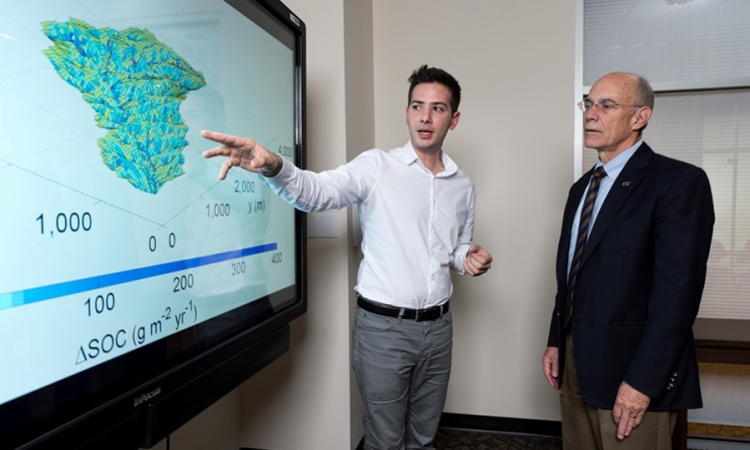
New model explains how soil erosion affects the amount of carbon in Earth’s atmosphere